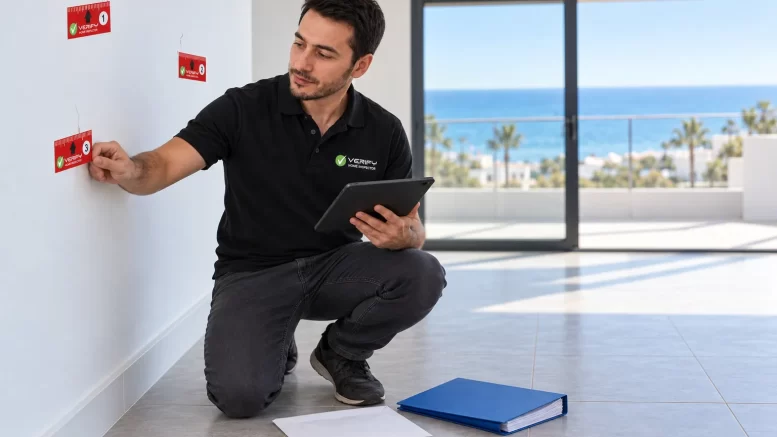
Buying a new build in Spain comes with strong legal protection, but only for buyers who act in the right order and on time. The court expert witnesses of Verify Home Inspector explain who is liable, the deadlines, the laws and the six steps to get a developer to fix the defects in your new home, or to pay for them.
Who is liable
Your claim goes to the developer (promotora) that sold you the home. Under article 17.3 of the Building Act (Ley 38/1999), the developer is always jointly liable with the builder and the technical team, so you can demand everything from it. Send a copy to the builder too: the Supreme Court has recalled that claiming against one party does not automatically stop the clock against the others. Defects in common areas (façade, roof, garage, pool, gardens) are claimed by the owners’ association through its president.
The deadlines: the clock starts before you get your keys
All the Building Act guarantees run from the acceptance of the works, a formal act between developer and builder that often happens months before your handover (article 6.5). Ask the developer in writing for that date.
| Period | What it covers | Law |
|---|---|---|
| 1 year | Defects in finishes: tiles, paint, doors, windows, sealing | Building Act, art. 17.1 |
| 3 years | Defects affecting habitability, including leaks and damp | Building Act, art. 17.1 |
| 10 years | Structural damage | Building Act, art. 17.1 |
| 2 years | To sue once the damage appears, interrupted by every written claim | Building Act, art. 18.1 |
| 5 years | To sue the developer for breach of contract, for example if the home does not match the specifications | Civil Code, art. 1964.2 |
| 15 days | For the company to answer your claim | Consumer Law, art. 21.3 |
| 30 days | Without an answer to your negotiation request, you can go to court | Organic Law 1/2025, art. 10.4 |
| 1 year | To file the lawsuit after the negotiation attempt | Organic Law 1/2025, art. 7.3 |
Two rules change everything. Whatever the specifications document (memoria de calidades) and the advertising promised is binding, even if it is not in your contract (Consumer Law, article 61). And any written claim interrupts the limitation period (Civil Code, article 1973), but only for the defects it names: a defect mentioned for the first time in court can be declared time-barred.
The documents you need
Contract and deed of sale, signed specifications and brochures, floor plans, the handover document, the user manual and Building Book, every email and message with the developer, and the company details (name, CIF and registered address) of the developer and the builder.
Step 1. The inspection and the expert report
A list made with your phone is useful to you. A report signed under oath by a court expert witness (Civil Procedure Act, article 335.2) is evidence a judge relies on. Every defect should have a code (INC-1, INC-2…), a location, a photograph, the rule or specification it breaches, its severity, the repair it needs and, if required, its cost item by item at market prices. Never over-claim: an inflated valuation makes a judge distrust the whole report. Ask for the defect list in a spreadsheet too, to hand to the developer.
Step 2. The email to the developer
Write in Spanish and attach the report. State that you «formally claim» the repair of every coded defect under the contract, the specifications and article 17 of the Building Act; those words interrupt the limitation period and put the developer in default. Ask for a claim reference and a reasoned answer for each defect within 15 days, offer the spreadsheet and a visit on specific days, and ask for the date of the acceptance certificate. Save the email and every reply.
If they send you to their after-sales portal
Many developers reply that every defect must be typed into their website one by one. They may offer the portal, but they cannot make your claim depend on it: Spanish law requires no particular form, consumer law obliges companies to accept claims by post and electronic means, and a single compulsory channel would be unfair. Register one request with the report attached, answer in writing that your claim is valid from its date, and move to step 3.
Step 3. The burofax
A burofax from Correos, the Spanish post office, certifies the content and the delivery. Order the certified copy and the proof of delivery. Online it accepts a PDF of up to 100 pages and 15 MB, so send two on the same day to the developer and the builder: one with the demand letter and the numbered list of defects, one with the full report. If you are abroad, your lawyer or a trusted person can send it. In Spanish, the letter must:
- Identify you, the home, the contract, the deed and the handover date.
- Cite the expert report and attach the numbered list of every defect.
- Recall your earlier email and that it was valid from its date.
- Base the claim on the contract, the specifications and article 17 of the Building Act.
- Give 20 calendar days to start the repairs or present a closed schedule, and to visit the home if they wish.
- State that the letter is a request for prior negotiation under Organic Law 1/2025: repair or, alternatively, payment of the valued cost.
- Warn that, if nothing happens, you will have the work done by third parties at their expense, after ten days’ notice, and interrupt the limitation period expressly.
Step 4. The developer’s visit and the repairs
Let them inspect, ideally with your expert present, using the same defect numbers. Ask for written minutes of what they accept and reject. Never sign a global acceptance: sign only what has really been fixed, defect by defect, and check every repair. A painted stain does not prove a leak is solved. Rejected defects remain claimed.
Step 5. Repairing it yourself and claiming the money
The Spanish Supreme Court accepts that the buyer may claim the cost of the repair instead of the repair itself, and even what was paid to have it done, once the developer has ignored a proven demand. To do it safely: when the 20 days expire, send a second burofax announcing the start date of the works at least ten days ahead, with specific dates for the developer to inspect; document everything before touching it; get several quotes using the same defect codes; repair only what was claimed; and pay by bank transfer against invoices. Urgent problems, such as a water leak, should be documented and fixed straight away. You can move in and furnish the home: signing the handover does not waive your rights.
Step 6. Going to court
If the developer still does not repair or pay, you file a civil lawsuit. Thirty calendar days after the burofax is received, the prior negotiation counts as attempted, and you then have one year to sue. Claims up to 15,000 euros go to a verbal trial and larger ones to an ordinary trial. Above 2,000 euros a lawyer and a court representative are compulsory. The expert report is filed with the lawsuit and the expert attends the trial to ratify it. As a rule, legal costs, including the expert’s fees, are paid by the party that loses everything.
A typical timeline
| When | What to do |
|---|---|
| Day 0 | Handover. Sign no global acceptance. |
| First week | Expert inspection, before furnishing. |
| Days 7 to 15 | Report received. Claim email sent. |
| 15 days later | No answer: the two burofaxes. |
| 20 days after the burofax | Deadline to start repairs. If nothing: second burofax. |
| 30 days after the burofax | You can file the lawsuit. |
The mistakes that sink most claims
- Counting the guarantee from the day you got your keys.
- Claiming in vague terms such as «the home has many defects».
- Relying on calls and messages instead of written claims.
- Refusing the developer access to the home.
- Repairing before the defect is documented.
- Waiting for promises. Promises do not stop the clock; written claims do.
Why a court expert, and not just a snagging list
A developer can ignore an opinion. It is much harder to ignore a report that describes each defect, grades it, proposes the repair and prices it, signed by an expert who will defend it in court. Every Verify Home Inspector report is backed by three legal specialisations: court expert witness in real estate, to assess the home and its value; in renovation works and faulty workmanship, to classify what has been built badly; and in fire and miscellaneous risks, to value each repair item by item. Our reports fit in a burofax, come with the defect list in a spreadsheet, include a second inspection to check the repairs, and can be delivered in English.
The full English guide, with every law and judgment, is on Verify Home Inspector’s new-build inspection page and in our guide to the Building Act guarantees.
This article is general information and does not replace advice from a Spanish lawyer on your case.
About the author
This article was written by the expert team of Verify Home Inspector®, court expert witnesses in real estate, in renovation works and faulty workmanship, and in fire and miscellaneous risks (IRD). Members of AEPEJU, the Spanish Association of Court Expert Witnesses (No. 810), with professional liability insurance of up to 450,000 euros. Based in Torrevieja (Alicante) and Seville, covering Orihuela Costa, San Miguel de Salinas, Alicante, Benidorm, Valencia, Murcia and Andalusia.
Web: verifyhomeinspector.com
Phone: +34 644 19 20 30
WhatsApp: +34 644 19 20 30
Email: info@verifyhomeinspector.com
Address: C/ San Policarpo 51, 4.º B, 03181 Torrevieja (Alicante), Spain
Free quote: request a quote online

Sé el primero en comentar en «New Build Defects in Spain: The Deadlines, the Laws and the Six Steps to Make the Developer Pay»